Friday, March 16, 2012

Hitchhiking West: Journey of the Zebra Mussel

Most people in the American West are unaware that an experienced hitchhiker is making its way across the country. Once it reaches Oregon, the waterways will be unrecognizable. I am talking, of course, about the zebra mussel.


These coin sized bivalves were first sighted on Lake St Clair in 1988. Since then they have expanded their territory to the entire Great Lake system. They were able to do this by attaching themselves to boats with strong, sting-like strands of protein called byssal fibers. Zebra mussels are microscopic as larvae and are able to float in the currents for a couple weeks before settling. Once settled, the juveniles are less than a millimeter in length, making them easy to miss. A single boat carrying one male and one female can infest an entire body of water. Females produce around 1 million eggs a year, causing their populations to exponentially increase (information about the zebra mussel life cycle can be found at http://el.erdc.usace.army.mil/zebra/zmis/zmishelp4/life_cycle.htm). Today, there are between 450 trillion and 1 quadrillion invasive mussels in Lake Michigan alone! Considering there are only 10 trillion cells in the human boy, this is a lot of mussels.

Modeling their population in a simple exponential model,
N(t)=N(0)e^rt
assuming 2 zebra mussels sparked the colony in 1988, and using the conservative estimate of 450 trillion, the growth rate for Lake Michigan is 137% a year! At this rate they will reach 21 quintillion (that's 18 zeros!) by 2020.


Where there are zebra mussels there are also quagga mussels (Dreissena rostriformis bugensis). Quagga mussels are a close cousin to the zebra mussel. They also came here in 1988, but they have taken longer to establish themselves in the Great Lakes. Now that they have made it to the lakes, however, they are starting to displace zebra mussels. Quagga mussels require water with less dissolved oxygen, so they are able to survive at greater depths than the zebra mussel. They are also able to attach to soft surfaces, such as sand or silt, while zebra mussels need a hard surface. Zebra mussels do have one advantage, however; the byssal threads they produce grow twice as fast and are much stronger than the quagga’s threads. So while quaggas are taking over in the lakes, zebra mussels still dominate quick moving waters such as rivers and streams. Less zebra mussels sounds great, but this isn’t a victory for our lakes. Quagga mussels have the same devastating effects zebra mussels do on ecosystems. In fact, they are so similar it took 3 years for scientists to realize there were two different species of mussels colonizing Lake Erie. As shown in the image below, the mussels do look very similar. Christine Moskell, from Finger Lakes Institute, explains quagga mussels and their relationship with zebra mussels very well in a paper that can be accessed at fli.hws.edu/sos/quaggaspdf.pdf.


Zebra and quagga mussels are so small it isn’t readily apparent why the public should care about their presence, or why they cost the tax payers between $1 - $5 billion annually. Despite their size, once established these mussels are able to collapse food chains, completely cover boats and other equipment, clog pipes, kill wildlife, and poison humans. Everyone should be aware of the implications of a zebra mussel colony, especially now that they are headed West.


The fishing industry is collapsing in the Great Lakes. Over the past decade the walleye industry alone lost over $350 million. Sport fish are affected so drastically because zebra mussels over filter the water, causing phytoplankton and zooplankton populations to drop more than 50% in most cases (see population map of Lake Michigan below). Without plankton, the small shrimp-like crustacean, Diporeia, is unable to find food and their populations consequently decline. Diporeia are important because they are the food source for many small fish who then feed the larger game fish. The decline in sport fish combined with the large costs of property damage (see above) is putting an immense strain on the Great Lake’s fishing industry; in the last decade many small fisheries have been forced to sell or go bankrupt.


Other industries are impacted as well. Water treatment and electrical generation facilities spend millions of dollars annually managing mussels. Microscopic larvae are able to flow through screens that are meant to protect the facilities' underwater pipes from aquatic life invasion. Once inside, they are able to establish themselves in the piping and even the facility itself (as shown below). The power industry alone spent $3.1 billion on zebra mussel management between 1993 and 1999. Zebra mussels have been the direct cause of several structural failures at the water treatment plant in Monroe, Michigan causing water 24,000 people to experience multiple water outages. With so many water-dependent facilities in the Pacific Northwest, the prevention of zebra mussels is a necessity.


Industries aren't the only ones impacted. Invasive mussels also affect the every day citizen. As a consequence of the mussels over filtering the lake water, the water becomes much clearer. Great, right? Better swimming! Actually, it is the exact opposite. Clearer water allows light to penetrate much deeper than usual. This large amount of light provides the perfect breeding ground for a toxic algae called Mictocystis. Besides being slimy and ugly, this alga secretes mycrocystin, a liver toxin that has been known to kill wildlife, livestock, and dogs. If inhaled or ingested it causes vomiting, nausea, headaches, diarrhea, pneumonia, and fever. Below is a picture of the shore of Lake Erie covered in Mictocystis.


Zebra mussels seem almost too much to control. A single male and single female are able to alter the chemisty of an entire body of water in just a couple decades. These guys are able to travel microscopically, causing them to be virtually invisible, for weeks before deciding to settle. And to top it off, they are able to live out of the water for 3 days as juveniles and 10 days as adults! The situation seems almost hopeless for Oregon, who boarders California where these guys have already been spotted. There is still hope, however. People aren’t surrendering the lakes that easily.

Thursday, March 15, 2012

The Zebra Mussel Invasion of the Great Lakes and its Ecological and Economic Impacts


image from: 
http://www.lakegeorge.net/images/zebra_mussel_toon.gif

After being accidentally introduced into Lake St. Clair via ship ballast water from their native Black and Caspian Sea in the late 1980's, the invasive Zebra mussel has caused a severe array of problems both for the human communities surrounding the Great Lakes region and the aquatic communities in the Great Lakes.  These tiny little bivalves, due to the fact that a single female can lay up to 1,000,000 eggs a year, have quickly established themselves in the area and have become quite the nuisance, to say the least.  Their impacts are distributed far and wide when examining indirect consequences, but their most direct impacts on the Great Lakes include out-competing native species, over-filtering the water, and attaching themselves to almost any surface imaginable.  Now, all these things might not seem like such a big deal, but indirectly, they pose serious and dire problems to life as we know it surrounding the Great Lakes.

Image from: http://www.learner.org/courses/envsci/visual/img_med/zebra_mussels.jpg
Because of their strong byssal fibers, the zebra mussel can attach to most hard surfaces and have been known to cling to shopping carts, water pipes, and boats.  In the case of water pipes, they cannot serve their given purpose if they have a bunch of little mussels taking up space inside and clogging the flow, so they need to be removed which can be costly and never-ending.  Maintenance crews will have to come back time and time again to remove pesky mussels from clogged water intake pipes for electric power generation and municipal water filtering facilities.  This can typically cost a lot of money; $3.1 billion between 1993-1999 for the power industry alone, to be exact (source).  Other methods of getting rid of the Zebra mussel include chlorine-based chemical controls, which can be effective in inducing mortality but yield dangerous environmental consequences, such as killing other non-target organisms, bioaccumulation, and the release of known carcinogens into the ecosystem.

Besides affecting areas of human concern in the form of economic damages and management difficulties, the establishment of Zebra mussels in the Great Lakes ecosystem has had severe detrimental effects on the local ecology and has even lead to the disruption of the local food web. 

One of the most apparent ecological effects that the zebra mussel has had on the Great Lakes ecosystem is the manner in which it filters the lake water.  Since they are filter-feeders, a single Zebra mussel can filter up to a quart of water a day.  Multiply that by a number on the order of millions and it becomes possible to filter all of the water in a lake or stream in just one day.  This has yielded much clearer lakes, which may seem great and beautiful and everything, but in actuality the increased solar penetration, along with other factors, has actually generated massive bright green toxic algae blooms.  Lake Erie, pictured below, has fallen victim to said algae blooms.  The Zebra mussel filters out most plankton and algal species, but chooses to leave behind a certain cyanobacteria called microcystis. This macroalgal species, mixed with their newly acquired lack of competition and phosphorous run-off from local farms and industry, is able to thrive.  Their eventual decay can deplete oxygen from the water and create "dead zones" where oxygen levels are so low that fish can't even survive.  (That's not good at all)

Image from: http://eoimages.gsfc.nasa.gov/images
/imagerecords/76000/76127/lakeerie_tm5_2011278.jpg
The other major effect that the Zebra mussel has been shown to inflict upon colonization sites lies in its ability to out-compete a tiny little shrimp-like amphipod called Diporeia.  Since around the time that zebra mussels were discovered in the great lakes, the numbers of Diporeia have simply plummeted  These little shrimp-like substances are a very important player in the Great Lakes food chain, for they are high in lipids and are a good source of calories for many larger aquatic organisms in the ecosystem.   

Image from: http://www.iaglr.org/jglr/db/show_article.php?
file_name=2001/num4/27_4_423-433.pdf


This survey, taken from Lake Ontario (Table 1), shows sharp Diporeia declines in most samples between 1990 and 1995.  Of the 15 sites sampled, 7 had become completely devoid of the important shrimps, 5 were drastically reduced, and 3 actually showed an increase in Diporeia density. Interestingly enough all of the sites that experienced a total depletion of Diporeia numbers were at depths lower than 50 meters, while those who experienced population increases were all at relatively deeper sites, perhaps hinting at the possibility that water depth is correlated with the stability of a Diporeia population.  

Image from: http://www.iaglr.org/jglr/db/
show_article.php?
file_name=2001/num4/27_4_423-433.pdf
As this graph (Fig. 2) shows, the density of Diporeia has quickly decreased to zero in almost all sample sites on Lake Ontario since the zebra mussel was established in 1989, with the exception of the mid-lake sample site.  The Diporeia populations near the shore and in the east side of the lake completely collapsed.  Even after two years of follow up surveying, none were to be found.   The increases in the mid-lake sample site make sense when combined with the numbers from the above table; the mid-lake sites are more likely to have a greater depth than nearshore sites, and thus this would also support the hypothesis that increases in water depth can be linked to increased probability of survival of Diporeia populations.

Since food webs typically function similarly to a stack of blocks, the removal of a single lower block can sometimes cause the whole stack to collapse.  Since the decline of Diporeia, a whole slew of other larger aquatic organisms have hopped on the band-wagon and started to decline in numbers as well.  The period between 1988 and 1996 saw a 95% decline in Lake Ontario lake trout and slimy sculpin numbers, while smelt stocks have also been heavily damaged by this lack of suitable food.  In Lake Erie, rainbow smelt and whitefish have seen dramatic declines.

In Lake Michigan, some fish populations are being forced to switch their diet from Diporeia to Zebra Mussels!  On first thought, this doesn't sound like such a bad thing because it shows that it is possible for native species to predate upon and hopefully contribute to the eradication of these hellishly invasive mollusks, but an examination into the caloric content of the Zebra Mussel will show that they offer little to no energetic value to their consumers.  One of the few things that they do seem to accomplish for those fish who do choose to consume them though, is that they take up space in their digestive tract and leave little room for food-bits that actually contain energy.  Thomas Nalepa, a research biologist at the Great Lakes Environmental Research Lab, said that "the [whitefish], whose guts became packed with shell material, were so skinny that fishermen could no longer get a fillet off them."
Because of this, the alewife fish has also seen a 23% reduction in energy density between pre-invasion and post-invasion surveys, which has caused the Chinook salmon, who prey upon them, to need to consume a corresponding 22% more alewives than before the mussel invasion to attain ideal body weights.

Any way you look at it, these Zebra mussels are posing quite the problem for the Great Lakes region, as well as everywhere else they are spreading to.  While the easiest and closest to home problems are easy to conceptualize in monetary terms, the bigger changes that they are causing in the ecosystem should be cause for larger alarm.  The difficulty of removing them only adds to this gargantuan problem.  Unless a way to successfully eradicate established populations and halt their spread can be found, we just might have to get used to these tiny rapidly-breeding pests and the non-refundable ecological collapses that accompany them.

Tuesday, March 13, 2012

The infamous cane toad: Is 85 years long enough to wait for Australian citizenship?

From the beginning of our modern evolution, we have had a great impact on our environment and the world as a whole. As humans we like to alter the area around us in order to improve our way of life. A good example of this is evident in invasive species. Whether as a piece of home or as a solution to a pest problem, we have a long history of bringing non-native organisms with us as we travel and settle new places. One of the most popular stories of an invasive species is that of the cane toad (Bufo marinus) and Australia (Fig 1).

Figure 1: Bufo marinus (cane toad)

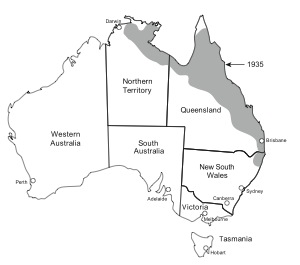
Before I delve into why the cane toads might carry an important message today, it’s important to go over a bit of their history. They were originally introduced into Queensland, Australia from Hawaii (a place where they are also an introduced species) to combat a problem with cane beetles infesting sugar cane crops (Fig. 2: arrow shows site of introduction). While the initial introduction contained only about 100 toads, in the subsequent years over 60,000 toads were introduced into northwest Australia. However, not only did these toads become the poster organism for invasive species, they did little if not nothing to control the sugar cane pests.


Figure 2: Site of initial cane toad introduction

Cane toads are a great example of all the traits that make “good” invasive species. The females lay tens of thousands of eggs a year and are able to lay these eggs in almost any body of water. Not only are these eggs not susceptible to the viruses or predators present in their native habitat, but the tadpoles possess a toxin that kills many of the animals that try to eat them. However, it isn’t just the tadpoles that possess this deadly defense mechanism, the toxin coats every life stage of the toad and provides a huge obstacle for any potential predators. Finally cane toads will eat just about anything both dead and alive, which makes them a menace to any native insects and small animals species.

These traits combined with their ability to survive in a wide range of climates have made them especially successful in Australia. While once just 60,000 toads on a small section of the coast, there are now more than 200 million toads spread over almost all of Queensland and into the Northern Territory. Figure 3 shows the spread of cane toads between 1940 and 1980. Due to their toxic coating, the toads have led to large decreases in many reptile, bird, mammal and rodent populations. In addition, their strong competitive edge has led to reductions in native toad species. Overall, the toads have had a huge impact on the biodiversity in their introduced region and are hypothesized to spread further into currently toad-free areas of west, and perhaps even south Australia.


Figure 3: Spread of cane toads from 1940-1980

While people have tried and proposed many methods for controlling the cane toad populations in Australia, nothing has been successful so far. Physical removal of toads merely provides the remaining toads with an even further competitive edge by removing intraspecific competition. Scientists have proposed the idea of genetically engineering a cane toad specific virus and introducing it into the population, but a method like that requires extensive funding, research and time. Professor Peter Koopman’s work on the sex chromosomes of the toad has provided an interesting idea for biological control. He has proposed a method by which genetically modified male cane toads that produce only male offspring could be introduced into the population and over time skew the sex ratio such that the cane toads would no longer be an issue. While ideas such as Koopman’s are inspired and quite creative, they too require large amounts of time and money in order to put them into action.

However, there might be hope. Scientists are starting to see changes in the way native Australian species interact with their new toad neighbor. Birds that once died from ingesting the cane toads are now selectively preying on the less toxic parts of the toad like the stomach. In addition, some native snake species have taken to consuming smaller cane toads and avoiding larger ones, which by extension have more toxin covering their bodies. Even more interestingly, young cane toads are more susceptible to the native meat ants as they do not possess the adaptive traits that allow for escape from these predators like their native toad counterparts.

I find this trend in adaptive behaviors in native species very interesting. After all, cane toads have been present in Australia for over 85 years. While I don’t think anyone would argue that they have not been a destructive force, over time perhaps their effect on the ecosystem is becoming more complicated. As time passes and native species adapt to the presence of the cane toad, is the toad considered part of the local habitat, or is it still a target for removal? Could removing an invasive species long after it was first introduced be potentially detrimental?

Imagine the Pacific Coast, with its large dunes rooted by European beach grass (Fig. 4) This grass, introduced on the west coast in the late 19th century has allowed for the stabilization of the dunes and the ability for other plant species to colonize closer to the coast line. While an invasive species, the eradication of this grass that has existed on our beach for over 100 years could have unforeseen effects not only on our man made infrastructure, but also on the ecosystems both in and around the dunes themselves.

Figure 4: European beach grass along an American coast

I think the same might be true for the cane toads. They have not only become part of Australia to some of the people who live there (as seen in Cane Toads: An Unnatural History), but they have caused both known and possibly unknown adaptive changes in the species around them. Not only is any method to remove these toads going to be costly in terms of time and resources, but it could also have unforeseen ecological effects.

Personally, I think that invasive species are a huge problem and that there are plenty of new, or relatively new harmful species that we could be focusing our time, money and energy to eradicate and control. In addition, we should be trying to find ways to avoid spreading more potentially invasive species by monitoring trade and rethinking some classic ideas around pest management. However, after 85 or 100 or even 200 years of unsuccessful management methods, perhaps devoting more time and research on an established invader will do more harm than good. By trying to control cane toads in Australia, we could be missing opportunities to combat invasive species that haven’t fully actualized their destructive potential.

Related Links:
Wikipedia: Cane Toads in Australia
Cane Toads: An Unnatural History: Youtube

Figure Sources:
Figure 1: Photo taken by Duncan Mclean
Figure 2: Shanmuganathan et. al. 2007 (see references)
Figure 3: Wikipedia
Figure 4: Photo from Oregon State University. Link


References:

Brown, Gregory P., Matthew J. Greenlees, Richard Shine and Georgia Ward-Fear (2009): “Maladaptive Traits in Invasive Species: in Australia, Cane Toads Are More Vulnerable to Predatory Ants than Are Native Frogs.” Functional Ecology, Vol. 23,. pp. 559-568


Koopman, P. (2006, June). Daughterless cane toads. Paper presented at Invasive animals CRC/CSIRO/Qld NRM&W cane toad workshop, Brisbane, Australia.

Phillips, B. L., & Shine, R. (2006). Adapting to an invasive species: Toxic cane toads induce mophological change in Australian snakes. Proceedings of the National Academy of the Sciences, 101(49), 17150-17155.

Shanmuganathan, T., Pallister, J., Doody, S., McCallum, H., Robinson, T., Sheppard, A., Hardy, C., & Halliday, D. (2010). Biological control of the cane toad in Australia: A review. Animal conservation, 13(s1), 16-23.

Tyler, M. J. (1998). Australian frogs a natural history. Ithaca, NY: Cornell University Press.

Control of Tansy Ragwort Invasion in the Pacific Northwest


Senecio jacobaea, more commonly known as tansy ragwort, is an invasive, toxic biennial weed that has been a serious weed problem in western Oregon, Washington, and northern California.  It was first reported in British Columbia in 1912, and in Portland in 1922.  In the Pacific Northwest it is often found in pastures and along roads and trails.  Ragwort has been declared a noxious weed in many areas and control is required in many selected counties.  This invasive weed is poisonous and lethal to native plants and animals, detrimental to soil quality, is a big hindrance to local economies, and poses a threat to the health of people in the community.
Figure 2. Tansy Ragwort once the flowering stems bolt

Figure 1. Tansy Ragwort in the rosette stage
Tansy ragwort is classified as a biennial herb.  As a biennial, the first year is spent in a rosette stage.  During the second year, the flowering stems bolt.  Initial infestation is by seed.  A large plant may produce as many as 150,000seeds, and the seeds can lie dormant for up to 15 years, which is why tansy ragwort is a very difficult plant to control and eradicate.  Furthermore, physical disturbances such as mowing or grazing often cause the plant to behave as a perennial [E. Coombs et. al].

A major issue with tansy ragwort is that it is noxious and lethal to many native plants and species in the communities that it invades.  The entire plant is toxic, but the most toxic part of the herb is the leaves, which generally are eaten while an animal forages for grasses and other target plants that grow near and around the tansy ragwort.  If the leaves dry out they still maintain their toxicity but not the bitter taste, and when mixed with hay or other silage it is not possible for the animal to detect or avoid the tansy ragwort when grazing or feeding.  Thus they unknowingly continue to ingest the tansy ragwort.  Tansy ragwort contains six different pyrrolizidine alkaloids that are converted to toxic pyrroles in the liverduring metabolism.  These pyrroles are generally both toxic and carcinogenic.

Figure 3. Chemical structure of pyrrolizidine alkaloids. Jacobine is one of the major pyrrolizidine alkaloids found in ragwort.

The damage to the liver is both irreversible and cumulative, and will kill the animal. Poisoning can also occur in young animals that are still feeding on the mother's milk, as alkaloids can accumulate in the milk and be passed from mother to young [E. Coombs et al].  Cattle and horses are the most vulnerable to poisoning but tansy ragwort has also negatively impacted population numbers of deer, pigs and goats. Ragwort fed  to goats at 1 percent of their body weight for 25 days, during lactation (for a total of 125% of the goat's body weight) caused abortions and subsequent death of  the does [Bedell et al]. Livestock are highly affected by tansy ragwort as the weed is very prevalent in pasture land.
Figure 4. Oregon Department of Agriculture Regional Survey. Average flowering plant density and number of cattle deaths diagnosed as pyrrolizidine poisoning at the OSU Veterinary Diagnostic Laboratory.

cinnabar-moth-catapillar
Figure 5. Cinnabar Moth larvae 
To get rid of ragwort, ideally biological control is preferred to spraying herbicides.  Use of cinnabar moths and adult flea beetles to control tansy ragwort in tandem has worked wonders in Oregon.  The cinnabar moth (Tyria  jacobaeae), was introduced into the Pacific Northwest in 1960 and is now widespread throughout the ragwort-infested areas west of the Cascade mountains [Bedell]. 
Figure 6. Flea Beetle
Figure 7. Cinnabar Moth
The larvae feed on the foliage and flowers and can completely defoliate the plant in large numbers.  However they only provide partial control of the tansy ragwort as they are relatively useless in controlling the rosettes.  The ragwort flea beetle (Longitarsus jacobaeae) eat the foliage during the fall, and the larvae mine the roots of the rosettes and kill plants in the winter and spring.  The beetles augments the cinnabar larval damage, coming at a time when the cinnabar moth is inactive [Bedell].

Ragwort control has significant economic benefits.  During the 1980s when the infestation was extremely bad, Oregonians reported an annual estimated loss of $4 million dollars from their livestock grazing on infested pastures [Radtke et. al].  Oregon legislature funded a measure that included a biological control program for tansy ragwort, which eventually curbed animal losses by $3.73 million annually [Coombs et al].  The benefit of biological control is reflected in a much lower livestock mortality rate, healthier livestock from purer feed, better crop yields, and a reduced expenditure on reactionary weed control methods, which accounted for another $2.12 million annually in savings [Coombs et al].  The biological control programs have cost around $240,000 annually in recent years [Coombs et al], and there clearly is a net benefit by saving farmers from millions of dollars in losses.  This has a positive effect on the entire community - market prices of local produce are a lot lower than they would be if farmers continued to suffer $4 million annually.  Furthermore, based on the dollar estimates over the 19 years, the calculated benefit-to-cost ratio for the entire state varied from 13:1 to 15:1, depending on the interest rate used.  The annual rate of return to the state of Oregon is greater than 80%, [Coombs et. al] which shows that this is a very cost-effective and necessary measure. 
Figure 8.  Percentages of annual savings due to control of tansy ragwort in Western Oregon.

Of course, there are many nonmonetary factors that justify this measure in itself. Reduction in the use of herbicides, improving wildlife habitat, and improving quality of life of livestock are all important reasons to take into account that cannot be quantified fiscally.  Control of tansy ragwort is essential for both economic and ecological reasons, as the entire community is adversely affected through the biotic and abiotic effects that the invasive weed has.


For More Information See

Image Sources
  1. http://www.co.stevens.wa.us/weedboard/htm_weed/tr.htm
  2. http://www.kingcounty.gov/environment/animalsAndPlants/noxious-weeds/weed-identification/tansy-ragwort.aspx
  3. http://www.biomedcentral.com/1746-6148/4/30/figure/F1?highres=y
  4. http://whatcom.wsu.edu/mgtemp/classes/weeds/PNW175.pdf
  5. http://www.treknature.com/gallery/photo640.htm
  6. http://www.agf.gov.bc.ca/cropprot/tansy.htm
  7. http://www.bugsandweeds.co.uk/moths%20p2.html
  8. http://whatcom.wsu.edu/mgtemp/classes/weeds/PNW175.pdf
References
  1. Bedell, Thomas E. et al. (1981) Print. Pasture Management for Control of Tansy Ragwort. Pacific Northwest Cooperative Extension Bulletin.
  2. Coombs, E., et al. (1997).  Tansy Ragwort. Pacific Northwest Weed Control Handbook 175
  3. Radtke, H et al.  1993.  An Economic Evaluation of Biological Control of Tansy Ragwort.  Oregon Department of Agriculture State Weed Board.  PP 31
  4. Sweeney, S.J. and K.E. Neiman, Jr., K.A. Lakey.  1992.  Alternative Control of Tansy Ragwort.  Prepared for Seattle City Light, Environmental Affairs Division, Parametrix, Inc.  Final Report of 1986 - 1991.
  5. Washington State Noxious Weed Control Board. (Dec. 1997). Web. Written Findings of the Washington State Noxious Weed Control Board.