Tuesday, March 6, 2012

Salmon: Not Just A Tasty Treat

Why are salmon so important? I myself was wondering why we should put so much energy and money into conserving the salmon population until I began to look at what the effects would be if they were gone. Native Americans believe that the return of the salmon each year represents the continuation and prosperity of all life. In a way this is true. Salmon are sensitive to their environmental conditions and their returning numbers depend on these conditions. Salmon bring a large biomass to the freshwater and terrestrial ecosystem. Their carcasses provide phosphorus to the land which is spread out by large apex predators, such as eagles and brown bears.  The carcasses also provide food for small invertebrate (whose presence indicates good water quality) which in turn are food for the juvenile salmonids.  When there is a decline in the number of salmon it indicates that our ecosystem is also declining.  This, however, is not the only reason we should care about salmon. A primary food source for most people and the jobs that are created from the salmon industry are in danger if we are to let the salmon population disappear. Thousands of individuals are employed each year in the salmon industry, and bring in millions of dollars in profits. The fate of salmon lies within us to try to restore our ecosystem, preserve our cultural heritage, and see to it that thousands of individuals keep their jobs.

 
The life cycle of the salmon begins in the gravel beds of streams where about 2,000-10,000 eggs (depending on the species of the salmon) are laid and fertilized. These eggs depend on a good oxygen flow from the stream in which they are laid in order to survive to adult hood. After about one to three months the eggs hatch to become alevins which feed off of their yolks sacs and rely on small pools within the stream to seek cover from predators. The salmon then become fry which live in small pools in the stream seeking small invertebrate for food and shading for shelter. The salmon must then be able to make the journey from freshwater to salt water in which they need to undergo a process known as smolting which occurs in an estuary. A smolt migrates to the ocean by rivers and can spend years in the ocean before returning to spawn. A spawning salmon will most likely return to the stream in which they themselves hatched, but there can be straying into other streams to spawn as well. After the spawning adults have laid and fertilized their eggs they will die usually within two weeks, although steelhead can return to the ocean after spawning.

A salmon population is part of a metapopulation. These metapopulations work together in asynchrony to create a viable dispersal of salmon. A study done in 2011* (Fullerton et al.) in the Oregon area on Chinook and steelhead salmon tested the effects that human activities have on the spatial structure of these salmon populations in the Pacific. The study compares the historical metapopulations against current possible situations of metapopulations shown in the figure below. The historical metapopulation assumed only natural barriers limited by fish access to streams; fish were of wild origin; and habitat quality and fish abundance were minimally affected by human activities. There were four  scenarios that were tested: restricted access (access to streams limited to areas below impassable hydropower dams, but other conditions remained as in the historical scenario); reduced habitat quality (fish restricted to areas below dams and instream habitat quality decreased relative to historical conditions); presence of hatchery fish (fish restricted to areas below dams and an increased probability of dispersal by hatchery fish relative to dispersal rates of wild fish); and myriad (multiple factors, including restricted stream access due to dams, reduced habitat quality, presence of hatchery fish, fish harvest, unfavorable oceanic conditions, and other unknown environmental factors).  Two other scenarios were introduced into the study: recolonization and preservation shown in the bottom of the figure below.

The figure to the above shows (a), that represents possible metapopulation spatial structures, and (b) which illustrates the spatial structure of salmon metapopulation resulting from the scenarios listed above. The black circles are populations that if recolonized would yield the largest increases in connectivity and the open circles are existing populations that would most disconnect the graphs if not preserved. The solid lines are existing connections while the dashed lines show the past connections. The circle sizes relate to the size of the population, and the ones that are boldly outlined are populations that need to be reestablished or preserved. This graphical analysis is useful when looking at which subpopulation of the entire metapopulation would have the most detrimental effects when exposed to human activity.

The overall experiment demonstrated situations in which the majority of the connectivity between the subpopulations in the metapopulation remained high and stable. Connectivity of the metapopulation as a whole is important because it increases the diversity of the salmon and increases the likelihood of survival when the environment changes or a disaster occurs. The connectivity and the variance within the study showed that the Chinook (fall and spring) and winter steelhead decreased with the addition of large hydropower dams and when there was a decrease in the habitat quality. The majority of the connectivity of the steelhead was due to the high stray rate from one population to another. High connectivity between the subpopulations was enhanced in general when salmon were straying indicating that it is necessary in a metapopulation and becomes much harder when there is restricted access to these areas. Hatcheries on the other hand increase the connectivity of the populations by introducing salmon into the metapopulation. This is due to the high stray rate of the salmon which occurs because they do not have a strong connection with their spawning stream. The myriad scenario is a scenario that is most like today’s salmon metapopulation, and represents the panmicitic populations shown in the figure where there is random mating between all the populations. This is un-favorable because there is a decrease in the amount of genetic diversity in the metapopulation which makes all of the salmon susceptible to any infection or disease or any adaption to environmental change.

Salmon populations not only rely on the connectivity throughout the metapopulation, but yet the asynchrony in these populations that is beneficial to the environment. The asynchronous pattern of salmon allows salmon to be introduced into the ocean at all times of the year from different populations. In a metapopulation context, asynchrony decreases global extinction risk and increases persistence time (*Heino et al. 1997).  The best example of asynchrony is seen and described in a study done by Lauren A. Rogers and Daniel E. Schindler, where they examined what the causes for asynchrony were. The results were: the importance of maintaining diverse spawning and the need for habitat conservation. Studies like these are vital because they  inform us of the necessary information and actions that we need to take in order to be able to help the salmon population survive and return to their spawning streams.

Overall, the conservation of the salmon population is important to all of us because we are linked to them culturally, they provide an indication about the state of our habitat, and without them thousands of jobs would be lost and there would be no tasty salmon to go around. This can be achieved through the conservation of metapopulations, but in a way that reserves the diversity of the salmon. Dispersing salmon from hatcheries is not the only way, and can be disruptive to the genetic diversity. With this knowledge of stray rates of hatchery fish we can better improve the rates of dispersal within a metapopulation to maintain that diversity. Maintaining habitats and removing or improving some of the hydropower dams will be beneficial towards the salmon population. Habitats can be improved by protecting or restoring areas that support the larger subpopulations, and logging can be reduced around main spawning streams. Salmon are still listed on the Endangered Species Act and are a main part of the way we live here in the Pacific Northwest; action must be taken to ensure that they will be here for many more generations.


Images:
1."Stepping up for Salmon 0." Stepping up for Salmon « EcoWatch: Uniting the Voice of the Grassroots Environmental Movement. Web. 06 Mar. 2012. <http://ecowatch.org/2011/stepping-up-for-salmon/>.


References:
1."Asynchrony PlayV2('en/US/st/stdjsfs5sjdyd3stssssyhh5h5');playV2('en/UK/st/stdjsfs5sjdyd3stssssyhh5h5')." TheFreeDictionary.com. Web. 06 Mar. 2012. <http://medical-dictionary.thefreedictionary.com/asynchrony>.

2."Basic Information about Estuaries." Home. Web. 06 Mar. 2012. <http://water.epa.gov/type/oceb/nep/about.cfm>.

3.*Fullerton, Aimee H., Steven T. Lindley, George R. Pess, Blake E. Feist, E. Ashley Steel, and Paul McELHANY. "Human Influence on the Spatial Structure of Threatened Pacific Salmon Metapopulations." Conservation Biology 25.5 (2011): 932-44. 

4. *Heino, M. et al. 1997. Synchronous dynamics and rates of extinction in spatially structured populations. Proc. R. Soc. Lond. B 164: 481-486

5."Learn More." CRITFC. Web. 06 Mar. 2012. <http://www.critfc.org/text/salmcult.html>.

6."The Life Cycle of a Salmon." Seymour Salmonid Society and the Seymour River Fish Hatchery. Web. 06 Mar. 2012. <http://seymoursalmon.com/lifecycle.php>.

7."Panmictic Definition." Web. 06 Mar. 2012. <http://groups.molbiosci.northwestern.edu/holmgren/Glossary/Definitions/Def-P/panmictic.html>.

8.Rogers, Lauren A., and Daniel E. Schindler. "Asynchrony in Population Dynamics of Sockeye Salmon in Southwest Alaska." Oikos 117.10 (2008): 1578-586.

9."Salmon Reproduction." Salmon: Reproduction. Web. 06 Mar. 2012. <http://www.marinebio.net/marinescience/05nekton/sarepro.htm>.

10."Smolting - Adjustment to Saline Water:." Web. 06 Mar. 2012. <http://www.holar.is/~aquafarmer/node21.html>.

11.Thompson, John N. "Metapopulation (ecology)." Encyclopedia Britannica Online. Encyclopedia Britannica. Web. 06 Mar. 2012. <http://www.britannica.com/EBchecked/topic/377988/metapopulation>.

12."Why Is Salmon Conservation Important?" Wild Salmon Center. Web. 06 Mar. 2012. <http://www.wildsalmoncenter.org/about/whySalmon.php>.

Climate Change and Ocean Acidification: What Do We Really Know?


Global climate change has the potential to impact the world, especially the oceans, in profound and dramatic ways. Carbon dioxide is a greenhouse gas that acts as insulation for the Earth’s atmosphere. As levels of greenhouse gases in the atmosphere rise, the Earth is more insulated and warms up. If the warming is drastic enough, sea levels can rise as ice melts and drains from the land to the oceans.
Carbon dioxide is also readily dissolved in water, and exchanges freely between the atmosphere and the ocean. The world’s oceans act as a huge sink for carbon dioxide—the oceans hold much more dissolved carbon dioxide than the atmosphere holds. Some of this dissolved carbon dioxide can be fixed into sugars and distributed through marine trophic systems by phytoplankton, photosynthetic bacteria, macroalgae (e.g. kelp) and marine plants.
Dissolved carbon dioxide forms carbonate ions and hydrogen ions. Original image.
Dissolved carbon dioxide also undergoes an equilibrium reaction, where it is converted to carbonic acid, bicarbonate ion and carbonate ion. A large influx of dissolved carbon dioxide shifts the equilibrium towards the production of carbonate and hydrogen ions. An extreme influx of dissolved carbon dioxide in the ocean could effectively lower the pH by increasing the concentration of dissolved hydrogen ions in the water. This poses a threat to organisms with calcium carbonate shells and exoskeletons because calcium carbonate is vulnerable to dissolution at certain pH levels. Shells made of calcium carbonate will not only dissolve in waters with lower pH, they will also be more difficult to construct. Elevated dissolved carbon dioxide concentrations (and the resultant low pH) could render developing invertebrates more vulnerable than they would be under today’s conditions.
Coral reefs are affected by ocean acidification in ways that have been studied extensively. The corals themselves are very sensitive to fluctuations in environmental conditions because they harbor important algal symbionts within their own tissues. The symbiotic algae provide most of the organic material for the corals in exchange for a stable habitat and basic nutrients. While corals can also feed on plankton in the surrounding water, they rely mainly on their symbiotic algae for nutrition. Coral bleaching is a well-known impact of ocean acidification and climate change. When environmental conditions—especially water temperature and local pH—fluctuate, the algae cannot photosynthesize and become stressed, causing the coral host to expel the algae. This causes the coral to lose its source of nutrition and color, and the coral dies soon afterwards.
A coral reef under normal conditions supports a high biodiversity. Photo courtesy of Mikhail Rogov.

Coral reefs that are unaffected by ocean acidification provide protected areas for fish to feed and live, and are often associated with high fish and invertebrate biodiversity. Bleached coral reefs do not display such vibrant diversity, and therefore do not provide the same ecosystem services that unaffected reefs provide. These services are generally important to people and include shoreline protection from wave action and tsunamis, plentiful fish stocks, and high water quality. Coral reefs are ecosystem engineers that provide a substrate for other organisms to occupy. Many invertebrates and fish make their homes within the coral structures, feed directly upon the coral or rely upon organisms associated with reefs to live successfully. When the coral dies, these important interactions may be broken, and species could become locally extinct.
Ocean acidification can affect specific organisms directly (e.g. weakening the shells of invertebrates) and it can impact different interactions between species. The effects of ocean acidification and global climate change on these different interactions have only recently been considered, and therefore the extent of these effects has not been well studied. One recent study by Cripps, Munday and McCormick (2011) explored the potential effect of ocean acidification on the olfactory senses of a coral reef predator.
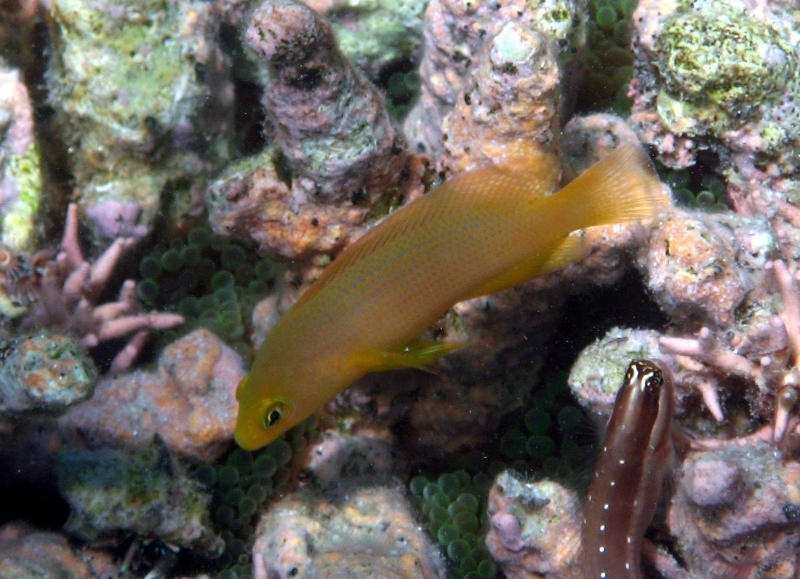
Olfactory senses in the brown dottyback (Pseudochromis fuscus) are affected by ocean acidification. Original photo.
The brown dottyback (Pseudochromis fucus) is a small mid-level predator that is found in the waters of the Indo-Pacific. It is known to prey upon the lemon damselfish (Pomacentrus moluccensis), which feeds on algae and small crustaceans. In the study by Cripps, Munday and McCormick (2011), adults of P. fucus were exposed to different levels of dissolved carbon dioxide (and therefore different levels of acidified water) and then were exposed to effluent from an injured damselfish. Fish that were exposed to high levels (predicted for both the near and distant future, if carbon dioxide emissions continue at a constant rate) of dissolved carbon dioxide did not respond as well to the prey’s smell. These results suggest that, in this species of fish, olfactory senses may be negatively affected by ocean acidification. The authors hypothesize that the mechanism for this effect may occur on the molecular level, where high levels of dissolved ions interfere with the chemical receptors for smell.
Even alone, the above results would greatly impact the predator-prey relationship between P. fucus and P. moluccensis. However, the effect of ocean acidification on fish predator-prey interaction may have a wider range of impact, thus increasing the effect on such an interspecies relationship. Previous studies on the effect of ocean acidification on larval fish indicate that fish reared in environments with high levels of dissolved carbon dioxide had more difficulty detecting predators and finding suitable habitat for hiding. The combined results could indicate that lower trophic levels may be more affected by ocean acidification than higher trophic levels.
Prey species such as the lemon damselfish (Pomacentrus moluccensis) may be affected by ocean acidification as larvae. Original photo.
In marine habitats especially, an alteration in the environment can impact the entire ecosystem in complex ways. An issue that seems relatively straightforward, such as ocean acidification, can influence the behavior and survival of many different organisms in a variety of ways. Trophic interactions are especially susceptible to impacts related to ocean acidification. A change in one predator-prey relationship can have a cascading effect throughout the entire food web of a habitat, and may potentially alter current dynamics between all the organisms involved in that system.
There has been increasing evidence that anthropogenic carbon dioxide released into the atmosphere is having a profound effect on the world around us. As a sink for carbon dioxide, the ocean is expected to experience huge changes in its chemistry if the current rate of carbon dioxide emissions continues. This could mean catastrophic consequences for the diversity of life in the oceans. These consequences are not limited to coral bleaching, but will likely affect most marine habitats. While the particulars of these results are not fully understood, it is clear that changes in trophic level interactions and habitat formation (especially by ecosystem engineers like the reef-building corals and oysters) can significantly impact the biodiversity of marine life.
Ocean acidification affects marine organisms in ways that are both known and unknown. We know that corals and their symbiotic algae become stressed when environmental conditions are slightly altered. We know that increased levels of dissolved carbon dioxide can prevent invertebrates and plankton from forming calcium-carbonate shells and exoskeletons. We now know that olfactory sensing in fish can be affected by changes in the pH of the ocean. It is unclear how every species will be affected by such changes, and we don’t know what other sensory systems may be affected by altering the ocean’s chemistry. The least understood piece of this puzzle is how greenhouse gas emission and ocean acidification will affect biodiversity on a larger time scale.


Resources:
Cripps IL, Munday PL, McCormick MI (2011) Ocean Acidification Affects Prey Detection by a Predatory Reef Fish. PLoS ONE 6(7): e22736. doi:10.1371/journal.pone.0022736

Ocean Acidification: Under the radar yet right under our nose


Except for a few summer months out of the year, that encourage a refreshing dip into the cool ocean or local pool, humans will spend the majority of their lives on land. We spend our time up here typically unaware of other life forms in other ecosystems, and the effect we have on them. Yes, global warming and its effects has made quite the appearance in many aspects of science these days, but to what degree have these increased CO2 levels actually had on other life forms? In particular, what is going on in marine ecosystems? We can go through a whole day without coming into contact with any marine organisms, and this may be a main reason we do not think about the unbelievable influences that our above-water-world has.
Our Earth and its atmosphere operate as one giant closed system. The components to this system, that are also integral parts of the carbon cycle, are the atmosphere above the ground and the aquatic environment below the ground. As a closed system the atmosphere will directly reflect the activity of the aquatic world and the aquatic world will directly reflect the atmosphere. Any toxins, namely CO2, we put into the atmosphere will eventually make it into the marine world.  
The most well know effects of the increased CO2 levels on marine ecosystems, also known as ocean acidification, have presented itself in the devastating form of coral bleaching. Healthy coral reef communities have a symbiotic relationship with a species of algae, known as zooxanthellae. The zooxanthellae assist the coral with their nutrient production from the photosynthetic cycle, and the coral provide the algae with a protected environment to live. When the conditions of their environment become unfavorable, that is a dramatic change in the temperature and pH of the water, the zooxanthellae will become unhappy with their living conditions. They will then start to die off and expel themselves from the coral reefs. Without the zooxanthellae corals will not be able to photosynthesize or produce any of the necessary nutrients, and in turn they will die and lose their elaborate coloring to a dull white gray. 


(photo credit: J. Hoogesteger)


But other then the most publicized aspects of global warming and ocean acidification, what is going on under the radar but right under our noses? In some populations of fish the ocean acidification has had effects on olfactory senses. Although the molecular mechanism by which this function is inhibited is not completely understood, there are many hypotheses surrounding this unsuspecting result of ocean acidification. The most general but widely accepted reason for this particular sense to be hindered is because it is a response to a chemoreceptor detection of CO2. Chemoreceptors detect CO2 levels in the blood and induce responses accordingly, specifically the olfactory sensory neurons will elicit the response for sent. Perhaps the constantly increasing levels of CO2 have caused the olfactory cues to wear out, and they can no longer transmit the signals for proper sent detection.
One specific case shows that in the Juvenile lemon damselfish species, Pomacentrus moluccensis, the olfactory inhibition could soon have a dramatic effect on their population sizes. They are the prey species to the brown dotty back, Pseudochromis fuscus, which will also be negatively effected by this oceanic change. Both species are reef fish that depend on the intricacies of a reef community to protect and provide a suitable habitat for spawning. Not only will their habitat, the coral reefs, be degraded to a bleached desert they will also lose their ability to sense one another resulting in a disruption of their predator-prey interactions.


(photo credit: Brown Dotty Back and Lemon Damselfish) 
In a paper by Cripps et. all observations showing unusual predator-prey interactions sparked enough interest to perform an in-depth experiment to further explain this relationship. Their conclusions showed that in an increased CO2 infused environment the prey were not as quick to detect the sent of predator presence or to find appropriate shelter to hind. When the experiment was conducted in pure ocean water the prey had quicker responses to the predators and were able to locate a better hiding spot for themselves and their eggs. There was also an observed difference in the response of the predator to available prey. Predators were roughly 20% less likely to locate and attack injured prey, easier meals, in increased CO2 waters then in pure ocean salt waters. Both parties of the predator-prey relationship are being negatively effected by this change in marine composition.
A question that I had after reading Cripps experimental discussion was: could there be a net loss of 0 if both the predator and prey are both harmed by this acidification? The answer is yes, if, and only if, they were effected equally and did not have any impact on other organisms. However this is not the case, the damselfish is significantly more impacted then the dotty back by this CO2 level change. The damselfish have lost their ability to sense the oncoming predator, to hide in a safe location, to hide their eggs in a safe location, and many of the possible productive habitat locations on a coral reef. On the other hand, the predators have only lost the ability to smell harmed prey, but are still fully capable of seeing their prey, as well as some reef habitat area as well. If the damselfish decline to their minimum viable population size and eventually crash then the population of dotty back fish will also start to decline due to a lost food resource. They will eventually reach a minimum viable population size and crash as well, causing their predator to fall into the same downward spiral. With consistently increasing CO2 levels and this possible crash of prey then predator, from the bottom up, the consequences will be catastrophic through the whole food web.
What does this all mean? Beyond the obvious solution of reducing our CO2 emissions and hoping to slow the degradation of coral reefs, which would protect many marine organisms from further damage, there is a more effective way to fight the issue. Awareness. If more people are aware of the repercussions of their actions then they would be more inclined to try to adjust their lifestyles. Education and knowledge of human impacts should go beyond the blanket statement of ‘global warming,’ it should try to connect humans to the world we live in through the bigger picture. Who would think that increased CO2 could inhibit a fish populations' sense of smell? We are just as much a part of the world as any underwater organism, the only difference being we have the power to make changes that will effect all life. It has been predicted that in 2100 the levels of CO2 could reach a staggering 950matm, which is a 550matm increase from the current day pelagic levels (Cripps). Rather then fixing the current situation of rising CO2 levels, we could focus on the next generations to come and how they can make a difference in slowing this destruction. Knowledge is power.


Monday, March 5, 2012

Acidification Adversely Affects All Aquatic Animals Appreciably

Coral reefs provide our oceans with more abundance of biodiversity than any other marine ecosystem.  Although they are merely small pockets within the vast expanse of ocean, they contain over 25% of the known species of fish worldwide.  Comprised of thousands of colonial polyps, corals secrete calcium carbonate (CaCO3) that hardens to form the intricate and protective reefs that these polyps, and many other marine species reside.  This process is known as calcification.  Corals are only one of many marine organisms that use this process to protect from the elements and predation, be it in the form of shells to the construction of exoskeletons.  Marine calcification is necessary for the most important members of marine ecosystems.  It is influenced by the carbon cycle, and more importantly it is influenced by the amount of carbon dioxide (CO2) circulating into ocean waters.  Even small changes in acidification as a result of increased CO2 output will potentially cause significant structural changes in the marine food web, and more importantly cause a substantial decline in biodiversity of these fragile communities.
 
A simple diagram depicting the natural flow of carbon through the three carbon sinks.  Image courtesy of: http://en.wikipedia.org/wiki/File:CO2_pump_hg.png
It is finally becoming irrefutably evident that human activity in the past few centuries is a direct contributor to the rapid increase of carbon dioxide (CO2) emitted into the atmosphere.  The subsequent damage to the environment as a result of increased CO­2 output is not fully understood, but what is understood is that increased emissions into the atmosphere are directly linked to increased acidity of the world’s oceans.  To help conceptualize this, think of the earth as a closed system, and the atmosphere, the crust, and the oceans as its three primary components.  Each component will hold a portion of the total amount of CO2.  As we extract the stores of CO2 from the earth’s crust (via oil wells, coal mines, etc.), it becomes atmospheric CO2 (after inevitable combustion).  The atmosphere will not hold all of this new CO2, however, because balance must be maintained between the three components.  The ocean responds by absorbing the atmospheric CO2 in a chemical reaction involving the release of hydrogen ions (H+), which helps to mitigate the climactic effects of increased atmospheric CO2, but resultantly decreases the oceanic pH. 

Marine Calcification is dependent upon the pH of ocean waters.  The average pH of ocean waters is currently about 8.1, or slightly alkaline.  This value decreased from 8.25 since the pre-industrial era, which is significant considering that this is on a logarithmic scale where a pH of 8 is ten times that of a pH of 7.  The most apparent impact of this sharp decline in oceanic pH is coral bleaching.  Coral organisms are very susceptible to changes in aquatic conditions.  Increased acidity leads to a decrease in the rates at which corals can calcify their protective shells, which makes them more vulnerable to erosion.  Bleaching is a result of this reduced rate in conjunction with increased surface water temperatures, which cause added stress to the fragile polyps.  In 1998, a single bleaching event caused the loss of nearly one fifth of global populations of coral.  The current levels of acidity alone may not be enough to cause the destruction of coral reef habitats, but the synergistic effects of acidification and increased surface water temperature have proven to pose a substantial threat to these ecosystems.  Using business-as-usual models, global ocean temperatures are expected to increase by as much as 5°C, and global oceanic pH may see a drop to 7.8.  Considering that coral can only resist temperature changes between 1-2°C, our global reefs are at considerable risk of extinction is nothing is done.


The threat posed upon corals is further propagated by the effect of acidification on their food source, plankton.  Many species of plankton form exoskeletons out of CaCO3, much like corals.  Models predict that within 100 years, global pH will inhibit the exoskeleton formation in these microorganisms so much so that they will not be able to survive.  The images above show the structural calcification of phytoplankton now (left) compared to structural calcification under predicted concentrations one century from now (right).  The images indicate that calcification is inhibited by acidification, and causes structural deformities in phytoplankton growth.  The most obvious difference in the two images is the spacing of calcified plates.  Under normal (current) conditions plates are evenly distributed, providing sufficient protection from the elements, but under conditions of increased acidification the plates do not form evenly and are perforated and broken.  This could prove to be devastating for phytoplankton and anything that feeds on them.

The visible effects of acidification are not the only effects on aquatic populations in the world’s oceans.  A number of studies are surfacing that attempt to evaluate the impacts of lowered pH on other aspects of organism physiology.  One study performed by researchers from the School of Marine and Tropical Biology examined the effects on olfactory senses of predatory reef fish common to the Great Barrier Reef off the coast of Australia.  The study involved comparing prey detection of the predatory fish,  the brown dottyback (Pseudochromis fuscus), in a control environment as well as two environments with increased levels of acidity (reflecting near and distant future estimates).  The study found that there were substantial declines in the predator’s awareness of prey, in this case the lemon damselfish (Pomacentrus moluccensis), in the elevated pH environments, in the prey’s detection of the predator, and in the prey’s ability to seek out safe locations to spawn.  The most troubling takeaway from this experiment is that elevated CO2 levels in the atmosphere may lead to conditions that have varying impacts on different species.  The two species from the study were affected, but there was a two-fold effect on the prey species.  This will likely have a devastating impact on the predator-prey balance in real-world conditions, and may even lead to the extinction of the prey species.

With the significant impacts of acidification on predator-prey interactions in mind, the inevitable changes in the dynamics of interacting species is clearly at risk for substantial if not complete loss.  Phytoplankton are among the most essential organisms for life in the ocean, corals house thousands of species of fish, and myriad other species are adversely affected by the changes in pH for reasons other than decreased ability to calcify CaCO3.  The consequences of acidification have been studied and examined in the wild.  There are potentially many more impacts that we have not accounted for, especially since the determination of the effects of acidification is relatively fresh in scientific community.  The risk that decreasing oceanic pH poses on the innumerable interspecific interactions in the world’s oceans merits a level of awareness not yet met by the general public.  Awareness is crucial, however, if we are to mitigate the consequences of acidification.  Otherwise we are rolling a dice, and the odds are not in our favor.

Sunday, March 4, 2012

Understanding Vaccines and the HPV Mandate Debate


“Is not vaccination a substitute, necessarily futile, for faithful obedience to the sacred laws of health, whereby alone health can be conserved and disease prevented?”

Unknown Author, 1878


VACCINE HISTORY:

The origin of vaccinations goes back to over 200 years ago when the scientist, Edward Jenner, observed that British milkmaids who had been infected with the mild viral disease cowpox, were immune to being stricken with highly lethal smallpox virus. Jenner collected the pus from the milkmaid’s scabs and inoculated healthy people with this biological material, conferring to them immunity to smallpox. He called this material “vaccine” (from vacca, the Latin word for cow), and the practice of vaccination was born.


The British government, after seeing the effectiveness of Jenner’s vaccine, implemented laws requiring mandatory vaccinations of their citizens, expanding the government’s role in public health. Opposition to these mandates spread quickly and in some cases led to violent riots. Interestingly, many of the arguments of modern-day opponents of state-ordered vaccinations are rooted in those expressed back in 19th century Britain.


ACQUIRED IMMUNITY:

When our bodies are exposed to some foreign material, such as a virus, immune cells create protein particles known as antibodies that specifically stick on to the foreign target, tagging it to be eliminated by other immune system cells. The process of creating these specific antibodies is not immediate, and therefore it takes time for the immune system to recognize and eliminate the foreign target. Depending on the characteristics of the virus and the strength of the host’s immune system, infection may persist for days or even years.

If a host were presented with the same virus again, it would mount a rapid and effective immune response, stopping the virus in its tracks. This is because our immune system ‘remembers’ the virus by keeping the effective tagging proteins, or antibodies, ‘on-file’. Vaccines work by taking advantage of this ‘memory’ of the immune system.

While there are many types of vaccines, ranging from ‘dead’ viruses to a mixture of viral proteins, they all present a host’s immune system with sufficient information to create antibodies against the virus of choice. Vaccines act like the primary exposure to a virus without the risk of infection. When a vaccinated person is exposed to a ‘live’ virus later on, its immune system can eliminate the virus before it does any damage.


HERD IMMUNITY:

When a sufficient amount of a given population is vaccinated against a virus, those who have not yet developed immunity against the virus are still protected to a degree. This is known as the herd immunity effect. To understand how this works, imagine an individual infected with the seasonal flu who coughs onto someone who has had their seasonal flu shot. The individual coughed on will not contract the flu virus because he is immune. The vaccinated individual has protected himself from infection, but he has also prevented everyone who he comes into contact with later on from the flu virus as well. In this way, vaccination slows down the spread of an infectious disease and can even lead to its elimination.


DISEASE ELIMINATION:

A disease’s basic reproductive number, known as R0 (pronounced ‘R-naught’), determines the critical proportion of a population that needs to be vaccinated (pc) for a disease to be eliminated.

pc = 1 – 1/ R0

R0 depends upon the transmission likelihood (β), the contact rate (c) and the duration of infectiousness (D).

R0 = βcD


If a disease had an R0 value equal to 2, this would mean that on average one infected individual would cause 2 others to become infected. It would also mean that for the disease to be eventually eliminated at least 50% of the population would need to be vaccinated against it.


HPV VACCINE:

In June 2006, the Food and Drug Administration (FDA) of the United States approved the first vaccine against the Human Papillomavirus (HPV), a sexually transmitted disease. The approved Gardasil vaccine developed by Merck protects those vaccinated from the four strains of HPV associated with 70% of cervical cancer cases in women and 90% of genital warts cases. A Centers for Disease Control and Prevention (CDC) committee soon after added the Gardasil vaccine to the list of recommended immunizations for young girls aged 11-12.

In the wake of this CDC recommendation, individual state governments began to introduce various pieces of legislation to help fund this expensive ($360) three-dose vaccine and in some cases requiring the vaccination for school attendance. In February 2007, the governor of Texas, Rick Perry, issued an executive order mandating that girls entering the 6th grade be vaccinated with Gardasil. His decision caused enormous public backlash and the Texas legislature soon repealed the mandate.


HPV MANDATE DEBATE:

One reason for opposing this mandate could be that current voluntary vaccination rates of young women are sufficient to eliminate HPV. As of 2010, only 32% of 13-17 year olds in United States have completed the three-shot regimen. Since women comprise about half of the US population, this means that the total vaccination coverage of young adults is around 16%. Using conservative estimates of β = 0.6, c = 1.4, and D = 2, from the primary literature, R0 for HPV is equal to 1.68. This makes the critical vaccination threshold for elimination (pc) equal to around 40%. This would correspond to a critical vaccine coverage level of 80% if only young women are vaccinated. Therefore, current voluntary vaccination rates of young women against HPV are insufficient to eliminate the infection from the population. One might wonder then why there is so much controversy surrounding the HPV vaccine, Gardasil, in an era where mandatory routine vaccinations are prevalent.

As previously mentioned, opponents of mandatory vaccinations have been around for a long time. However, in modern-times, anti-vaccinationists are usually in the minority. In the current case of mandated HPV vaccination, though, opponents appear to be in the majority. What then is making the Gardasil vaccine such a controversial issue?

First of all, the Gardasil vaccine is relatively new to the market. While it has passed the rigors of FDA testing, the long-term effectiveness of the vaccine is unknown. Current studies show that the vaccine protects women for at least five years, but when most cervical cancer cases occur about 30 years after the recommended age of vaccination, the immunity to HPV might wear off.

Second, HPV infection is unlike many other communicable diseases in that its transmission is through sexual contact. While good hygiene may reduce one’s likelihood of contracting the seasonal flu, total isolation from others is the only 100% effective strategy. On the other hand, the contraction of HPV can be simply avoided by abstaining from sex. You can’t control if someone coughs on you, but you can control your sexual behavior.

Finally, mandating that only young women bear the risks and costs associated with HPV vaccination is unfair treatment. Men can contract HPV and get genital warts as well as a host of cancers, including penile cancer. While the Gardasil vaccine was originally targeted towards women, due to HPV’s close association with cervical cancer, solely mandating the vaccine for women is discriminatory. In a heterosexual population where most women are vaccinated with Gardasil, the men are effectively protected from HPV without having bore any of the cost.

Government mandated vaccines have caused the effective elimination of smallpox and polio among other diseases in the past. How the government should control the spread of HPV is still up to debate.

Our inner selves: The microbes that call us home


What do you think of when you think of bacteria? Up until a few years ago I took a decidedly unfriendly view: bacteria (and viruses forthat matter) were something to avoid as much as possible and they didlittle for us besides make us sick.
Bacteria: The Silent Majority

It turns out that the role that microbes play in our lives is much more complex than that of simply a pathogen. All plants and animals arehome to a large and diverse number of microbes.

The numbers are truly staggering. If you do a census of the cells in your body you’ll find 10 times morebacterial cells in you than human cells (Ref. 1). Additionally, there is about 150 times moremicrobial DNA than human DNA in your body. Admittedly prokaryotic cells are much smaller than eukaryotic cells-so by mass there is only "10" pounds or so of bacteria living on and in you, most of which is in your gut.


These bacteria are not just passive residents of our bodies.Rather, it's becoming increasingly apparent that the makeup and composition ofour very own bacterial community, or microbiome, has important consequences forour health. Many disorders, such as type II diabetes, obesity, irritable bowelsyndrome, and asthma have been correlated with a change in the makeup of ourgut microbiome (Ref. 1). In other words, people who have type II Diabetes have, on average,different phyla of bacteria present in their gut than the average individual.This suggests that studying the microbiome is rewarding for two reasons. First,it might lead to new and innovative ways of treating diseases in humans.Second, if you want to understand the basic biology of animals (in particularhumans) it's necessary to understand what our tenants are up to.

In the last decade the study of the microbiome has exploded,driven largely by the rise of cheap high-throughput gene sequencing. Bacteriacan be classified by doing 16s sequencing (Ref. 2). The 16s sequence is ahighly conserved RNA sequence that is used to construct the prokaryoticribosome and because it's believed that that the function of this gene hasn'tchanged over time variations in the 16s sequence can be used to classifybacteria into different phyla. For classifying bacteria this is particularlyuseful because it's often hard to classify bacteria by phenotypes (mostbacteria just look like rods to me) and most bacteria can’t even be cultured ina lab.


The Human Microbiome. Relative abundances of different phyla are shown for different body parts (Ref. 3)


This technique is enormously powerful and it allowsresearchers to get a complete picture of all the bacterial residents of anorganism. Researchers are starting to use this technique to catalogue all thebacteria that lives on humans and the variations in those species, as part ofthe Human Microbiome Project (Ref. 4). The results coming out of this project are really remarkable. The distribution of bacteria on different parts of the bodies varieswildly (see figure above). There’salso evidence that the distribution of bacteria that live in our guts belong toone of three communities, each of which contains hundreds of different species,but that are distinct from each other (Ref. 5). The bacteria that inhabit us are not just a hodgepodge of bacteria taken from the earth around us. Instead our microbiome consists of bacteria that have found their particular environmental niche: us.

While a genetic approach is powerful, it also has itslimitations. There are two ways that gut samples are collected for genesequencing: taking stool samples or dissecting and sequencing the entire gut(obviously impossible with humans). Data taken using the first technique onlylets you get a sense of the bacteria that are leaving the gut and may notaccurately reflect the percentage of different bacteria that reside in the gut.For instance, it may be the case that a subset of bacteria are particularlyeffective at adhering to the wall of the gut and can’t be easily removed. Theother approach, dissecting the gut, only gives you information about the gut asa whole and doesn’t tell you anything about any spatial variation that might bepresent, for instance if different bacteria establish themselves in differentecological niches. The other problem is timing: you can't constantly bemonitoring the types of bacteria in the gut (especially if you’ve dissectedit!) and it may be the case that there are important temporal variations indistributions of bacteria.

With these issues with sequencing in mind there might be alot to be gained by watching the colonization of the gut by bacteria. Our grouphas recently been working with the Guilleman Lab, also right here at theUniversity of Oregon, to do just this, by imaging the dynamics of gut bacteriain zebrafish (a species of minnow).

Now we're not studying zebrafish for the sake ofunderstanding the biology a certain type of fish, but because zebrafish aremodel organism for a variety of human conditions. Model organisms are non-humanspecies that are used to test and understand biological systems.Because many biological features are heavily conserved over the course ofevolution this approach is often well justified.
A: Brightfield image of a zebrafish. Scale bar: 500 microns.B: Sketch of a zebrafish, with the gut highlighted in green.


Zebrafish are a relatively new model organism (moreestablished ones that you may be familiar with are mice, e. coli, and fruitflies) that was pioneered right here in Eugene (Ref. 6)!

Zebrafish aregreat to work with for several reasons. They're relatively easy to raise andbreed. Also, Zebrafish are fairly amenable to genetic manipulation. Finally,and most important to our work, they're optically transparent when they'reyoung. This somewhat unique feature makes it possible to directly imagebacteria colonization of the gut-something you can't do with other modelorganisms, such as mice, that have guts.

Initial colonization of the gut. Left Panel: 4 hours after inoculation with bacteria. Right Panel: 6 hours after inoculation. Scale bar: 100 microns.

Along the lines of model organisms, we are also looking at a "model" gut. Our collaborators have developed a technique to raise germ-freezebrafish. These fish have, from the point of birth, never been exposed to anybacteria. Not a single one. We then introduce fluorescently labeled bacteria(bacteria that have been engineered to produce fluorescent proteins that make them glow when struck by laser light) into the water the fish are living in. This gut is a “model” in thesense that we’re ignoring all the potential complexity that will arise fromhaving a lot of different bacteria in the gut at once and focusing instead onsimpler interactions. From this foundation we can then (hopefully) build up increasinglayers of complexity.

After a couple of hours the bacteria have found their wayinto the zebrafish and we take them and put them on a microscope. Themicroscope that we’re using is called a light sheet microscope (Ref. 7), arelatively new design of microscope that allows us to quickly image with micronlevel resolution along the entire length of the gut. This type of microscopedesign is gentle enough on the zebrafish that we can image them for hours oreven days at a time.

Bacteria colonizing the length of the gut. Anterior is to the left.

Above I’ve included a picture of what the gut looks like 6hours after bacteria have been introduced to the water the fish was in. A couple things areimmediately obvious. The distribution of bacteria is very heterogeneous withthe majority of the bacteria residing towards the anterior of the gut. There isalso a wide range of size of bacterial clumps. In other words, there is a largeamount of spatial variation within the gut and this suggests that we may seethings by imaging that can’t be explored by genomic-based techniques.

Through microscopy we can begin to peer at the dynamics ofan ecosystems that all of us animals carry around with us every day. There area lot of interesting questions one can ask. For instance, what happens when twotypes of bacteria, either from different species or that have differentphenotypes (e.g. a chemotaxis mutant- a bacteria that can’t move in response tothe gradient of different chemicals in its environment), are both introduced tothe gut? If the bacteria are introduced at different times will the firstspecies establish itself in the best environmental niche and prevent the laterarriving species from successfully colonizing the gut? What about if the laterarrival has a competitive advantage (for instance if the first bacterialspecies lacks chemotaxis)? How will that affect competition between thespecies?

We can do a field study of the main players in an environment that stretches not over the length of a forest, but over a humble couple of millimeters of gut. How can you gain information about the spatial and temporalfeatures of an ecosystem (or any system for that matter)? There are a varietyof powerful mathematical techniques that have been developed to extract thistype of information from signals even when the signal is noisy (which all reallife data certainly is!). I’ll go over two of these techniques in class:Fourier and wavelet analysis and show they can be used to answer ecological questions.

References

(1) Our microbial selves: what ecology can teach us. Gonzalez, et. al., EMBO Reports, 12, 775-784 (2011).
URL (firewalled): http://www.nature.com/embor/journal/v12/n8/pdf/embor2011137a.pdf

(2) 16S rRNA Gene Sequencing for Bacterial Identification in the Diagnostic Laboratory: Pluses, Perils, and Pitfalls. J.M Janda and S.L. Abbott, J. Clin Microbiol, 45, 2761-2764 (2007).
URL: http://www.ncbi.nlm.nih.gov/pmc/articles/PMC2045242/

(3) Unravelling the effects of the environment and host genotype on the gut microbiome, A. Spor, et. al., Nature Reviews Microbiology, 9, 279-290, (2011).
URL (firewalled): http://www.nature.com/nrmicro/journal/v9/n4/pdf/nrmicro2540.pdf

(4) The Human Microbiome Project: http://commonfund.nih.gov/hmp/overview.aspx

(5) Enterotypes of the human gut microbiome. Arumugum, et. al., Nature, 473, 174-180 (2011).
URL (firewalled): http://www.nature.com/nature/journal/v473/n7346/abs/nature09944.html

This research got plenty of press coverage that is not (or just nominally in the case of the NY times) firewalled, for instance:
https://www.nytimes.com/2011/04/21/science/21gut.html

(6) http://www.neuro.uoregon.edu/k12/george_streisinger.html
Gives a nice biography of George Streisinger and goes into the early history of zebrafish husbandry (which seemed to include a lot of trips to the Albany, OR pet sore)

(7) http://www.lmg.embl.de/lsfm.html
Link contains a nice review of the microscopy technique from the pioneers of this technology.